
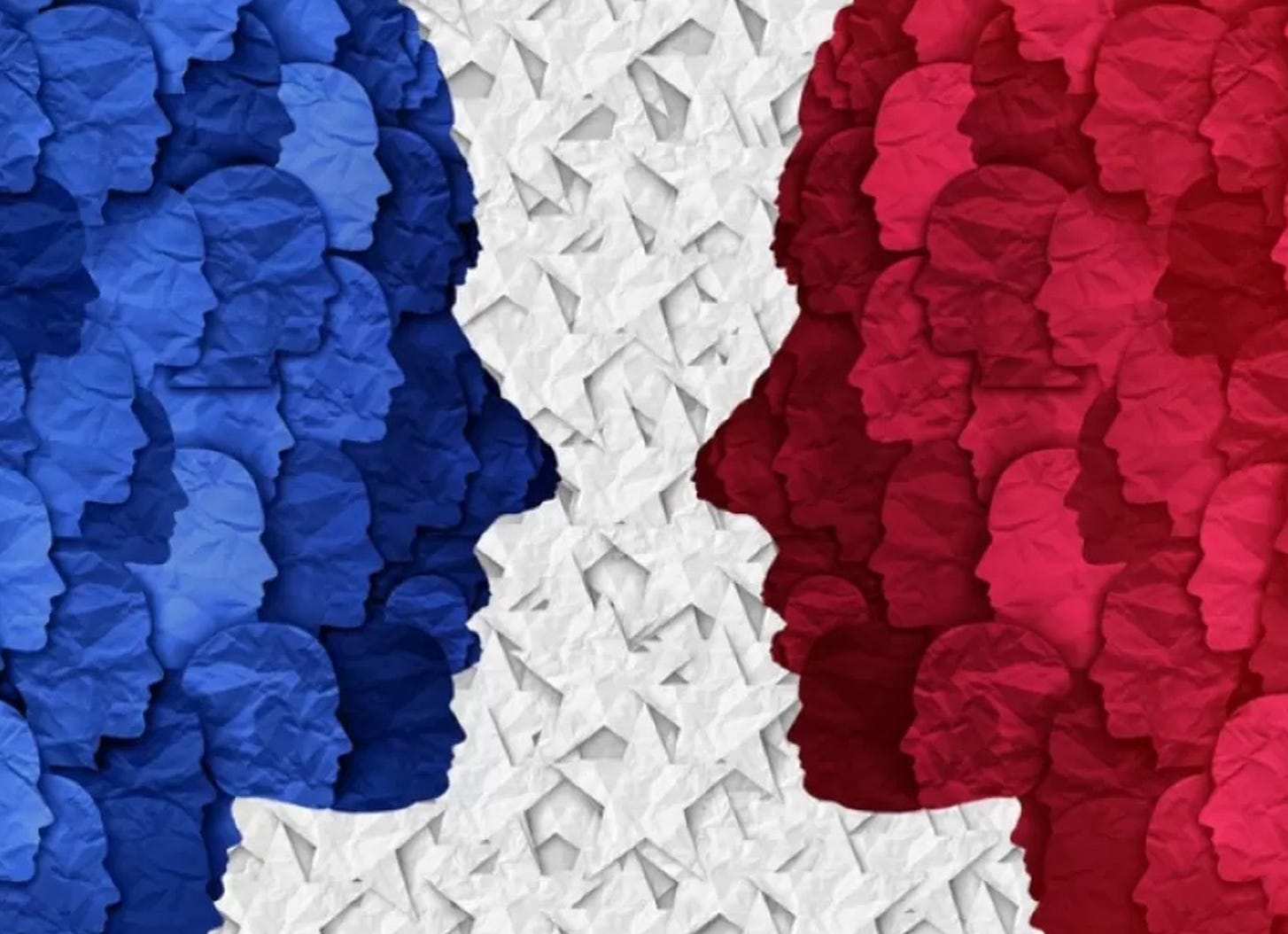
Right versus Left. Here we go again. I can already hear the knives coming out. Fine. Let’s try something slightly less bloodthirsty this time and look at what each side actually thinks it is doing, rather than the cartoon versions we usually throw at each other.
Both sides, if you strip away the slogans and the rage, are trying to build a community. They both want a place that feels like home, a shared identity that holds people together instead of letting them fly apart like shrapnel. They just have completely different ideas about how you get there, and what you’re allowed to keep once you arrive.
The conservative, or at least the classical Right-leaning view, starts with the individual. Each person is more or less on his or her own to become the best version of themselves they can manage. Community is not something a committee designs and then drops on your head. It is supposed to emerge. Free people, left mostly alone, tend to form families, churches, neighbourhoods, and habits that look a lot like one another. Shared language, shared stories, a rough moral consistency (the Ten Commandments still work surprisingly well as a starter kit), and a preference for the people who actually live next door rather than an abstract “humanity.” Love is personal first—your kids, your spouse, your actual neighbour—not a government program.
If you want that kind of cohesion to last more than a generation, you cannot treat every incoming culture as equally compatible. Some things will erode the foundation. So the Right, at its more honest moments, admits there have to be limits. Diversity is fine when it adds to what’s already there. It stops being fine when it starts dissolving the very thing that made the village worth living in to begin with. That is not hatred; it is pattern recognition. You can call it exclusion if you like. They call it self-preservation.
The progressive, or Left-leaning view, starts at the other end. Community is something you construct from the top, or at least from the middle, through rules, institutions, and a central authority that decides what fairness looks like. The great moral project is inclusion: every culture, every belief, every identity gets a seat. Equality is not just a goal; it is the operating system. The assumption underneath is that all these different ways of being are, at bottom, compatible—or can be made compatible if we just apply enough education, regulation, and goodwill. Good luck with that.
Here is where it gets sticky, and where the shrew in me starts twitching.
The Left also holds a set of very rigid, universal moral standards. Women must be treated a certain way. Speech must stay inside certain lines. History must be narrated a certain way. These are not suggestions; they are non-negotiable. Fair enough—every culture has non-negotiables. The problem is that the Left rarely notices that its own preferred culture (let’s call it late-liberal, secular, therapeutic, equity-focused) is itself a very particular culture. It is not a neutral container that can hold every other culture without changing them. It has its own priests, its own heresies, its own sacred texts. When a genuinely different culture arrives with different ideas about family, sex, authority, or the sacred, the progressive project has to choose: either water down its own standards or start policing the newcomers. In practice it does both, then pretends it is still being “inclusive.” Look at how the Left perceives the Christian Right (don’t even mention “Christian Nationalism” to a liberal). It isn’t pretty. So much for “inclusion.”
That is the contradiction that never quite gets resolved. You cannot demand universal conformity to a specific set of progressive norms and celebrate radical pluralism at the same time. One of them has to give. Usually it is the pluralism. The village that was supposed to contain every possible village-version ends up looking a lot like one particular village with extra flags.
I am not saying the Right has this all figured out. Their version can calcify into nostalgia, or worse into a kind of ethnic or religious club that treats outsiders as permanent guests at best. And “just let individuals be free, and community will magically appear” ignores how much shared culture already has to exist before that freedom doesn’t turn into atomized loneliness and shopping malls. We all have seen that particular movie.
But the Left’s version has a built-in impossibility. It wants the warmth of belonging without the boundaries that create belonging. It wants the moral confidence of a creed while insisting creeds are oppressive. It wants a strong cultural identity that is simultaneously infinitely elastic. That is not a political program. That is a pipe dream.
From a psychological angle—this is the part I can’t help but tell you about—both sides are wrestling with the same old human problem: how much difference can a group absorb before it stops being a group? The Right answers by tightening the circle and hoping the people inside it still have enough room to breathe. The Left answers by widening the circle until the circle itself becomes the only identity remaining, and then wonders why people feel rootless and start inventing new tribes out of pronouns and grievances.
The agenda, of course, loves the fight. As long as we are screaming at each other about which village is the real one, we are not looking at who actually owns the land, who writes the zoning laws, and who profits from the demolition. Divide the frogs, and keep the pot on the stove. Classic.
I do not hate the Left. I have said that before, and I mean it. Plenty of people I love live on that side of the fence. What I cannot pretend is that their model, as currently practised, can deliver the community they claim to want. It keeps tripping over its own idealism. The Right’s model is narrower, sometimes colder, and frequently hypocritical, but at least it admits that a culture is a thing with edges.
So here we are. Two incomplete maps of the same territory. One starts with the person and hopes the village appears. The other starts with the village and hopes the person still matters. Neither is going to save us by itself. The shrew’s job, as usual, is just to notice when the tidy map they’re handing us—Right’s version or Left’s—doesn’t match the actual ground we’re standing on. And then to keep asking the question neither camp seems eager to sit with: what, exactly, are we willing to share—and what are we willing to lose—in order to have a place that still feels like home?
I don’t have the tidy answer. I just know both sides are describing a village they have never quite managed to live in at the same time.

If you would rather not subscribe at this time, and maybe give a little just for this article, please click the button above and give as much as you feel is comfortable. This helps me immensely in keeping up with my writing! Thank you so much!
Live and let live bro! It seems you are leaning rightwards with its exclusion zones and its 'white' agenda. Extreme views like policing language etc are not exclusive to the left and I hope to god you don't really believe that brown-skinned people and women are somehow only relevant to the left-leaners because.....well if I have to explain it to you, I've lost you.
Or maybe you've lost me.
It is all about division. And since the plandemic it has clearly been the goal. As people are turning against each other, 'the powers that shouldn't be' are clapping.
I hope you are doing well Todd. Missed you last week. :)