

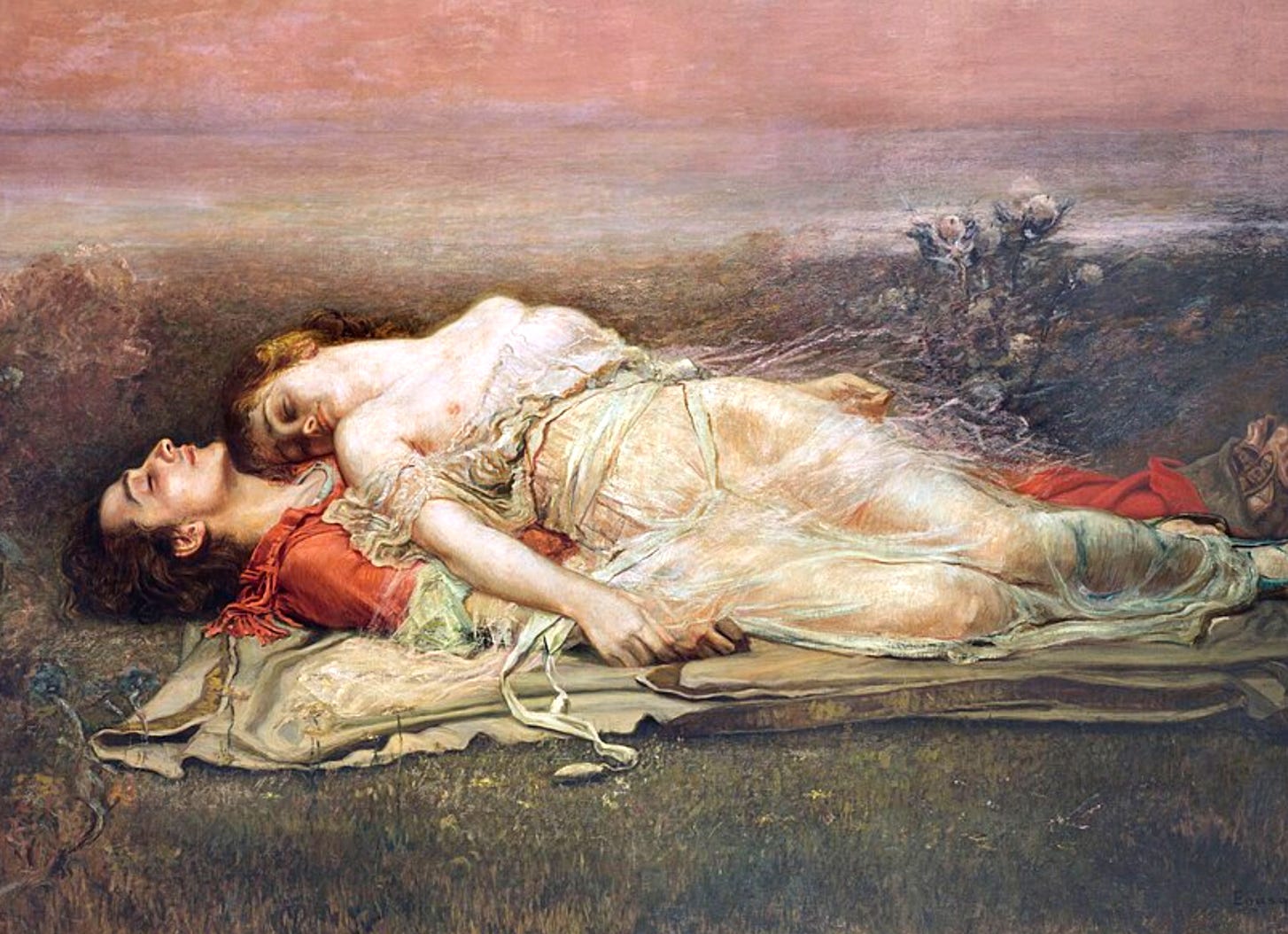
Just when I thought it was safe to go back into the water, the ubiquitous shark of wokeism raises its ugly head. I’m using this as the first sentence mostly to be dramatic; it’s not entirely truthful.
First of all, I know damn well it will never be safe to go back into the water—at least not in my remaining lifetime. Second, my tentative toe-dip wasn’t consciously an escape from our turbulent times. Though I must admit, I didn’t expect what happened next.
The water I dipped into was the grand ocean of musical art—opera in particular. Most of you know I’m a trained musician; music was my first passion and remains a lifeline. To stay sane, I periodically (less often than I should) venture into pure musical ecstasy. For me, “musical” means the old stuff: Beethoven, Tchaikovsky, Wagner, et al. Recently, I booked a seat at a Cineplex for the Met’s live HD stream of Wagner’s colossal classic, Tristan und Isolde.
This opera is a favourite for several reasons. First, it’s Wagner—one of my top composers, not just for his music but for his profoundly Jungian, archetypal approach to myth and the psyche. Second, Tristan und Isolde itself is a deep dive into one of my best-loved archetypal themes: anima projection! In fact, it’s probably the most prominent and accurate artistic presentation of this subject in all of opera. Robert Johnson, the renowned Jungian scholar and author, wrote a whole book (We) about this roughly 800–900-year-old medieval myth (in its written forms) that Wagner based his opera on.
Wagner’s Tristan und Isolde (premiered 1865) retells the core of this medieval romance with profound psychological depth, emphasizing the archetype of anima projection—that intense, unconscious projection of one’s inner feminine ideal (the anima, in Jungian terms) onto a real person, creating an overwhelming, almost mystical romantic obsession. Tristan, the heroic Cornish knight, has slain Morold, the Irish champion and Isolde’s betrothed, in single combat to end Ireland’s tribute demands on Cornwall. Mortally wounded himself in the fight, Tristan disguises his identity as “Tantris” and sails to Ireland, seeking the famed healing arts of Isolde, daughter of the Irish king. She nurses him back from the brink, only to discover—through the matching sword fragment—that he is the killer of her fiancé. In a pivotal moment, she raises his sword to slay him but spares his life when their eyes meet, allowing him to depart with his promise not to return.
Later, Tristan returns—not to keep her for himself, but to claim Isolde as bride for his uncle, King Marke, in a political match that humiliates her further and dishonours the mercy she once showed him. This betrayal, layered atop the death of Morold and the shame of having healed her enemy, ignites Isolde’s burning hatred and sense of wounded pride as she is transported across the sea to wed the aging king.
Aboard the ship to Cornwall, a fateful mix-up occurs: Isolde’s confidante Brangäne substitutes a love potion for the death potion Isolde intended them both to drink in despair. The elixir ignites an all-consuming passion between Tristan and Isolde—an ecstatic, forbidden love that overrides duty, honour, and reason. This is no ordinary romance; it is the anima unleashed in its most destructive form. Tristan projects onto Isolde his longing for wholeness, transcendence, and escape from the daylight world of social obligations and ego-bound existence. Isolde, in turn, sees in Tristan the animus figure who completes her, drawing her into a realm beyond ordinary life. Their love becomes a totalizing force: day (the world of convention, King Marke, marriage, continuity) is the enemy; night (the realm of passion, dissolution, and mystical union) is the only truth.
The tragedy unfolds inexorably. Their affair is discovered, leading to betrayal, exile, and mortal wounds. In the final act, Tristan, dying from a lance blow, awaits Isolde in delirium. When she arrives, she sings the sublime “Liebestod” (“love-death”), dissolving her individuality into the “world-breath” in ecstatic annihilation. There is no reconciliation in life, no progeny, no legacy—only complete surrender of the ego, body, and all material ties. Wagner’s vision refuses partial fulfillments or sentimental redemption; the soul’s quest ends in utter dissolution into the numinous oneness, where love and death become indistinguishable. This is the radical, unsparing core: projective love destroys everything in its path, demanding total annihilation rather than any softening compromise with the world.
What a story.
This kind of all-consuming passion rarely plays out in its absolute entirety in real life, but it certainly flares up partially in countless relationships. Look at other famous renditions of such unions: Romeo and Juliet, Antony and Cleopatra, Lancelot and Guinevere, Heathcliff and Catherine in Wuthering Heights, and Paolo and Francesca from Dante’s Inferno.
Humans have repeatedly wrestled with this archetype in their desperate effort to meld with the divine through another person. That is what this kind of love truly is—at its core and in its feeling. When it is allowed to reach its full conclusion, as Wagner does so uncompromisingly in Tristan und Isolde, it demands a complete departure from the earthly world. Everything material is consumed in the fires of love: other relationships, other allegiances, careers, ambitions, possessions, even one’s own ego and individual identity—everything.
In real life, most of us pull back from the abyss long before reaching this total annihilation. The ego is a stubborn survivor. Society, family obligations, fear of complete psychological dissolution, and the sheer demands of daily existence all act as powerful brakes. We compromise. We soften the projection. We settle for manageable affection, domestic comfort, or even the quiet comfort of children and legacy—the very things Wagner refuses to allow his lovers. We do this because the full Tristan path is terrifying: it is not just romantic love, it is ego-death. Most humans have tasted at least a shadow of this intensity—the overwhelming projection, the sense that this one person holds the key to transcendence—and most have had to contend with the painful necessity of pulling back from the edge.
This is precisely why Tristan und Isolde is such a powerful symbol. It takes the anima projection to its most extreme, logical, and honest conclusion. Wagner does not flinch. There is no softening, no redemption through progeny, no “life goes on” consolation. The “Liebestod” offers only ecstatic dissolution into the world-breath. In doing so, the opera holds up a mirror to the terrifying beauty of what this love actually wants: not happiness, not continuity, but total surrender. It is pure genius how this is conveyed in Wagner’s creation.
Then the woke-shark raises its ugly head.
This Met production—a new staging by visionary director Yuval Sharon, premiered March 9, 2026, with the formidable Lise Davidsen as Isolde—decided to “update” Wagner’s masterpiece for our wonderful, fully safe, fully sanitized, modern woke world by making Isolde pregnant.
You read that right. Pregnant.
After all that buildup, all that annihilation of ego and world, Isolde enters the final scene (Tristan already dead or dying at her feet) visibly carrying a child in her womb. They didn’t dare rewrite the libretto to justify this narrative-busting addition—no lines about conception or gestation—but the visual was unmistakable. She even gives birth onstage, right beside Tristan’s body. Brangäne lovingly tends to the newborn while Isolde sings the Liebestod—whose meaning is now twisted into something entirely different. After her ecstatic dissolution into the “world-breath,” the non-world, Brangäne hands the infant to King Marke, who gently kisses its forehead as the curtain closes.
Unbelievable.
I nearly stood up in my Cineplex seat and booed the screen. How could they get this so catastrophically wrong? And why?
All I could think was this: our woke-era agenda demands that everything remain safe, antiseptic, and affirmational. No raw suffering, no unmitigated tragedy, no silence after the fire has burned everything to ash. The producers and director—intentionally, as Sharon has explained—frame the opera as a meditation on cycles of death and rebirth. The central tunnel set doubles as a near-death experience and a birth canal. The pregnancy and onstage birth transform the ending from Wagner’s grim, uncompromising finality into an “ecstatic mystery of renewal.” Love destroys, yes—but look, there’s a baby! Life goes on, continuity is assured, everything is redeemed through procreation. Sounds like a nice idea, eh? But it is uptopic in this context, and thus dystopic.
This is the precise inversion of the opera’s spiritual core. Wagner’s Liebestod is a vision of total annihilation: Isolde dissolves every material tie—body, ego, individuality, future, progeny—surrendering utterly to the numinous oneness. The myth and the music refuse partial fulfillments, the sentimental cushions most people clutch to soften the ache of impossible love: sex, family, children, legacy. The soul’s quest ends in complete refusal of the material world, not its affirmation. There is no “hope” here, no renewal. There is only terrifying beauty in the void.
By inserting a superfluous infant and turning the Liebestod into a “life goes on” moment, this production domesticates the archetype. It offers emotional safety instead of the soul-shattering surrender Wagner demands. It reflects the broader cultural refusal to face unsoftened tragedy. This is wokeism at its most insidious: not overt politics, but the quiet tearing down of the past, the watering down of profound human truths, the sanitizing of suffering and the human condition itself. We cannot bear the archetype’s demand for total dissolution, so we slap a bow of regeneration on it and call it progress.
This isn’t a misunderstanding. It’s a deliberate rejection of the tragic design. And in a world already drowning in nonsense, it’s one more veil we must continue efforts to pierce.
What enrages me most is not the artistic choice itself—it’s what it reveals about our era’s cowardice. This is the same evasion I see daily in therapy: clients who refuse the slightest discomfort, who won’t look squarely at the tragedy buried in their unconscious, who flee pain rather than feel it long enough to heal. They want transformation without sacrifice, wholeness without shadow.
Wagner’s opera refuses that lie. Its genius lies in showing love as the moth driven inexorably to the flame—what must we annihilate, what must we give up entirely, to be engulfed by love’s full fire? The ego, the future, continuity itself—all consumed. Throwing in a baby at the opera’s final moments ruins that unflinching truth. It doesn’t symbolize hope; it symbolizes denial. “Don’t look too closely at the abyss—see, here’s a baby, all is redeemed, life goes on nicely.”
We don’t have to abandon hope. But real hope begins only when we stop pretending life is all beauty and perfection. Truthful life has shadow, sacrifice, unbearable pain—and that’s not a flaw to fix; it’s the human condition to face. The original opera doesn’t end happily, and that’s precisely why it’s profound. Learn from it. Honour the tragedy. Let the music burn away the illusions. No Disney ending needed—just the courage to sit with the ashes and embrace what remains.
"...visionary director Yuval Sharon..." Really? He has transformed a legendary creative work of art into a thought terminating cliché.
I totally agree with you. I once walked out of a Shakespeare play performed as a western, but what you describe is much worse. I enjoy listening to Tomita's Snowflakes Are Dancing by Debussy, but I can't stand living in a world where the snowflakes have taken over. What happened to true grit?