
Just saw the movie “Wild Horse Nine.” Excellent film. Go see it. It probably isn’t for everyone—it is a bit eclectic—but I loved it. It made me cry. And it is also very shrew-like in nature, so check it out and tell me what you think.
Basically this is the story. Two longtime CIA partners—Chris, the older, sharper, and frankly more unhinged of the pair (played by John Malkovich in what feels like a career-best turn), and Lee, his younger, steadier counterpart (Sam Rockwell)—get sent from Santiago out to Easter Island in 1973, right on the cusp of the coup that toppled Allende of Chile. Officially it’s a little R & R among the moai. Unofficially, of course, nothing in that CIA world is ever just R & R.
Chris is dying. Cancer, dementia, the usual quiet demolition of a man who’s spent decades doing the sort of things the rest of us prefer to pretend governments don’t do. He’s started recording his memoirs. The usual greatest hits: Guatemala, the Bay of Pigs, Lumumba, and yes, a lingering thread that runs all the way back to Dallas in ’63. Their bureau chief, MJ (Steve Buscemi, perfect as the harried middle-manager of the empire), wants those memoir tapes stopped before they leave the island. Lee is the one who’s supposed to stop them. And stop Chris as well.
What follows is pure McDonagh (the director and screenwriter of the film): black comedy that keeps tipping into something gentler and more brutal at the same time. Two men who’ve killed for the same masters, who’ve covered for each other, who speak almost entirely in insults because any other language would be too naked, now have to decide what loyalty actually looks like when the machine that owns them starts eating its own. Along the way they cross paths with a couple of idealistic Chilean students who still believe the world is about to get better. One of them, at least, is not what she seems. The island itself—those massive stone heads staring down at everything—does what Easter Island always does in a story like this: it makes the human schemes look small, temporary, and faintly ridiculous.
Is it shrew material? Hell yes. It’s about the people who do the dirty work of the agenda, the ones who tell themselves they’re protecting something larger while they dismantle other people’s countries and other people’s futures. It’s about the moment when even the loyal ones start to see the machinery for what it is. And it’s about the last scrap of something human that survives inside men who’ve spent their lives erasing the human. Friendship, in this case. A promise kept at the end of the world, or at least at the end of one man’s world. Not redemption, exactly—McDonagh doesn’t do clean redemption—but a final, private refusal to let the institution have the last word.
It made me cry because it understands that even the people who carry out the worst of it are still people. That doesn’t make what they did right. It just makes the whole thing sadder, and funnier, and more recognizable.
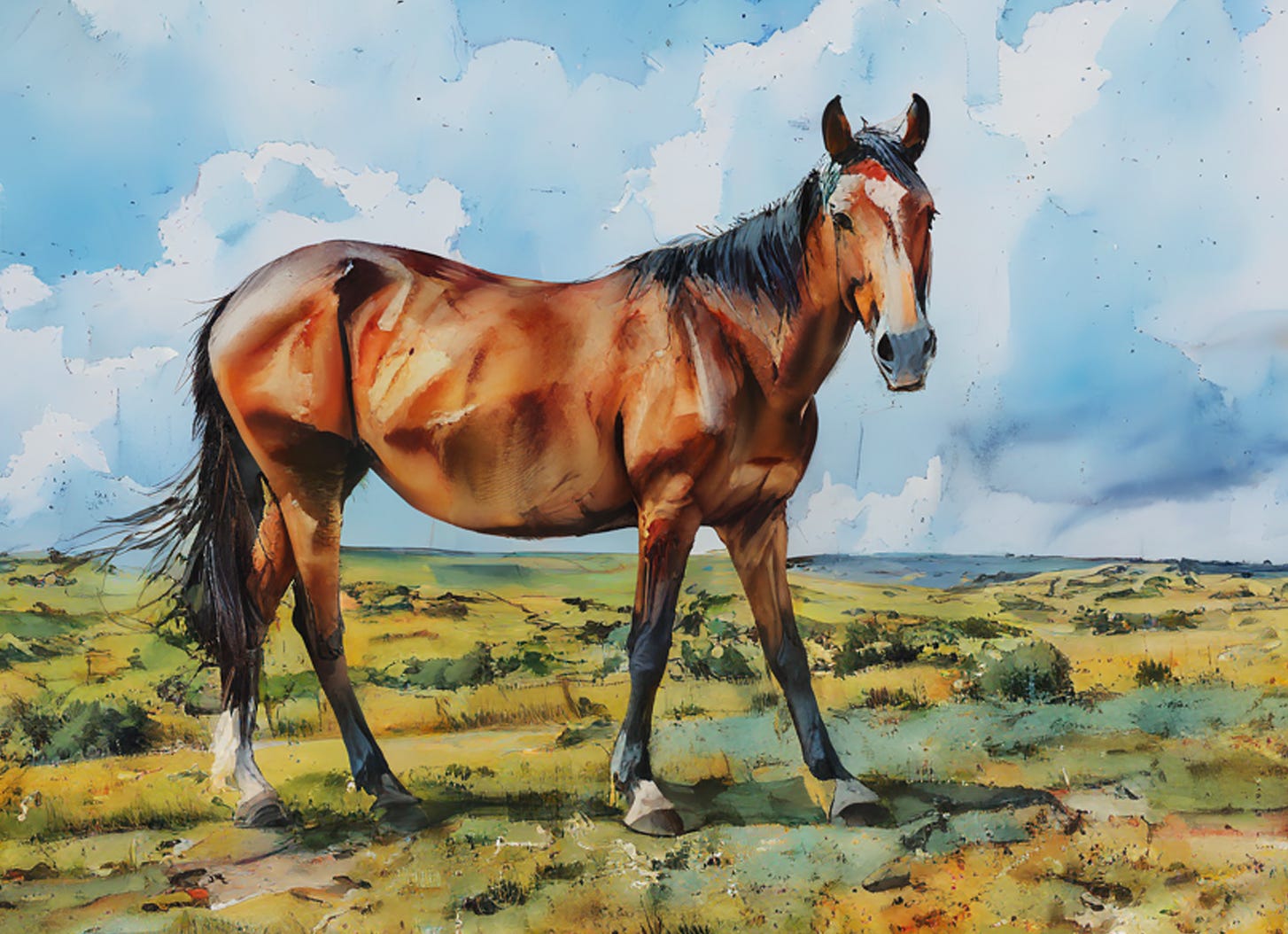
Then there are the horses—the true soul of the film. Chris, the dying man, connects with them and realizes he may have been so busy trying to change the world as a young man, in a rather horrific way, that maybe he missed the whole point of life. “I liked this horse,” he says after kneeling down next to his equine friend, whom he had just met the night before. The horse shows up mysteriously dead by the roadside as he and Lee are driving back to their hotel.
The movie is wonderful in the way it subtly winds and turns through the black-and-white objective horror of assassinations, CIA historical antics, including JFK’s death in Dallas ten years earlier, and the personal pathos of the last days of a dying man trying to come to terms with his death—whether he was truly an evil man who had killed 68 people in the term of his service as a CIA agent, or a man who will be welcomed into heaven because he had the heart to save moths he found in his hotel room.
For me, the culmination of the movie is the small speech Chris gives to Monica (Mariana di Girolamo), one of the two idealistic Chilean students he and Lee encounter on the island. She is the more radical of the pair, still convinced that marches, revolts, and the right kind of politics can turn the tide of political injustice. Chris, looking at what is left of his own life and the body count that built it, tries to disabuse her of that hope. He was explaining that she should give up her efforts to change the world, to rectify the injustices she saw in her idealistic liberal stance. His view is that there is nothing you can do through revolts, marches, and even voting (ha ha!!). But instead, this was the most effective route. Here is the speech in full:
You want to know what you can do to stop it?
Whenever you see a guy in a uniform, any kind of a uniform, a soldier, a cop, kill him.
Whenever you see a guy in a CIA suit and tie or a KGB suit and tie, kill him.
And if you see a little kid who wants to join the army when he grows up because he likes the camaraderie, he likes the boots, kill him.
Kill him as a child.
And you know what? You still won’t stop him. There will always be more of him.
So what you do instead is find yourself a hut on the beach somewhere, somewhere remote.
Keep your back to the ocean and your eyes on the treeline, and wait there with a gun until they come for you.
You’ll still die, but at least you’ll die with the wind in your hair.
His choice to invoke violence would be typical of a man who only saw violence as a solution his entire life, but his realization that the problems of the world were just too big and complex to make a dent in with peaceful ways of action, and even the violent ones were pointless because there would always be more of them, even if you eliminated all of the politicians, soldiers, and other men and women in service to the agenda. However, the best action is to get away, to find a shack on the beach, and live your life. They will eventually get you, but as they say in the south, “they can kill ‘ya, but they can’t eat ‘ya.” Die, but die with the wind in your hair.
“Die with the wind in your hair” is the image of dying free—outside the machine, not inside it. Not in a hospital bed hooked to tubes, not in a prison cell, not as a loyal functionary still taking orders, not as someone who spent their last years arguing on the internet or waiting for the next election to fix things.
It means dying on a beach (or in a hut near one), with the actual air moving across your face, having chosen the terms of your own life even if you couldn’t change the larger world.
Chris isn’t promising survival or victory. He’s saying the system will eventually find you and finish you. The wind is the small, final difference: you met the end without having given them the whole of yourself. You kept the last scrap of open sky. That’s the shrew version of freedom in Chris’ speech—not changing the world, not winning, just refusing to die already owned.

If you would rather not subscribe at this time, and maybe give a little just for this article, please click the button above and give as much as you feel is comfortable. This helps me immensely in keeping up with my writing! Thank you so much!
Well this makes me want to see the movie. " ... not changing the world, not winning, just refusing to die already owned" - this is maybe all we can really hope for. It is difficult to get a loved-one to see a different view and we certainly can't vote ourselves out of the mess that has been made. So maybe finding a small beach hut is the answer. Thanks Todd.