

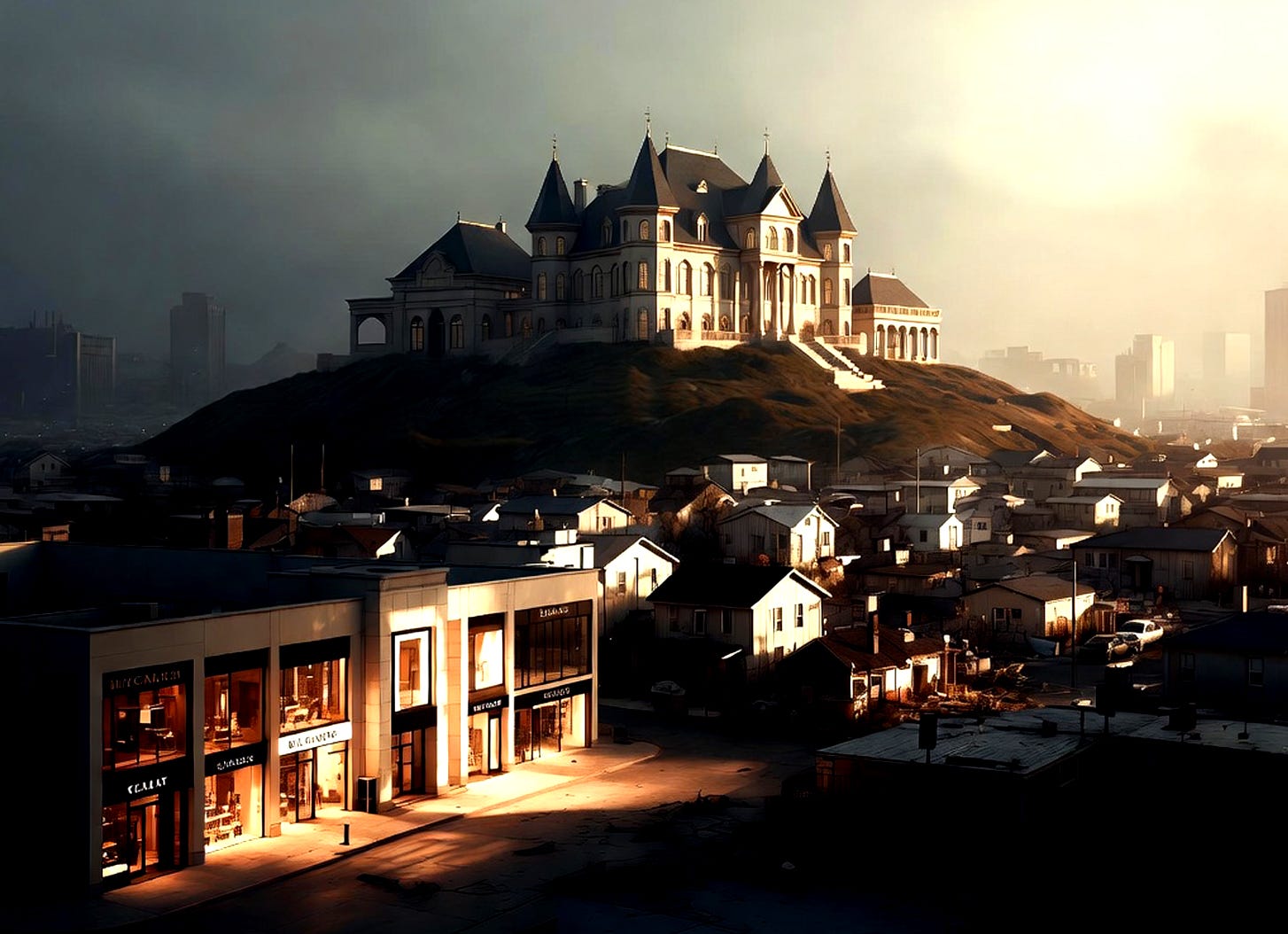
Here’s yet another thing that bugs Dr. Shrew to extinction. Drive through any unassuming suburb and behold the gleaming 10,000-square-foot monuments to excess sprouting like mushrooms after rain—while the rest of us scrape by on fast food and fret over five-cent gas hikes. This glaring disconnect between perceived scarcity and ostentatious plenty whispers of deeper currents: not mere luck or hard work, but an economic shadow realm where the rules of reality bend for some and crush the rest.
I don’t know if this is true where you live—more than likely it is, especially in big-city suburbs such as the Greater Toronto Area where I reside. But the spectacle repeats itself across countless American and Canadian metros. Add to this the proliferation of high-end shopping malls sprouting up nearly everywhere. Rural shopping centres may be spared the worst of it, but in populated regions, the contrast is impossible to ignore.
Who supports all of this? Not just the flagship luxury anchors like Saks Fifth Avenue or Nordstrom, but the hundreds of smaller (yet still premium) retailers such as Lululemon, The Gap (and its sister brands), Anthropologie, Madewell, and Abercrombie & Fitch. These stores don’t typically sell $10,000 handbags, but shoes and women’s purses don’t have to reach that stratosphere to feel expensive. A “nice” pair of designer shoes or a quality leather tote can easily set someone back several hundred dollars—well beyond the reach of many scraping by on stagnant wages.
When I was a kid, the elite who could casually afford a $10,000 watch were few and far between. They may have to shop in exclusive boutique retailers nestled in the good parts of major cities like New York City, Paris or London. Now they seem a dime a dozen. A decent Rolex that might have cost around $3,000 in 1990 now starts at about $10,000 and can climb to $100,000 or more for exotic models. You can walk into a jewelry store in your local mall—sandwiched between a Walmart or Target—and drop $20,000 to $80,000 on a Rolex, Tag Heuer, Breitling, or Cartier. Who in hell does that? How do these high-end businesses thrive, not just in flagship downtown locations but in suburban malls across the country?
I guess the same folks who own the big mansions also visit the malls. They grab a taco at Taco Bell, then stroll over to Neiman Marcus to buy a Hermès Birkin purse for $40,000. Yeah, go, girl.
Who are these people? They are the visible avatars of a bifurcated economy—professionals, executives, and entrepreneurs who have ridden waves of asset inflation, tech booms, finance, and selective opportunity. Many are dual-income households in high-earning fields: tech executives, finance professionals (bankers, investors, hedge fund managers), corporate lawyers, specialized physicians (surgeons, anesthesiologists), real estate developers, successful business owners, and mid-to-senior level managers in lucrative industries like consulting, pharmaceuticals, or energy. A significant portion also includes inheritors or those who benefited from generational wealth transfers, real estate appreciation, or stock market gains over the past two decades.
