

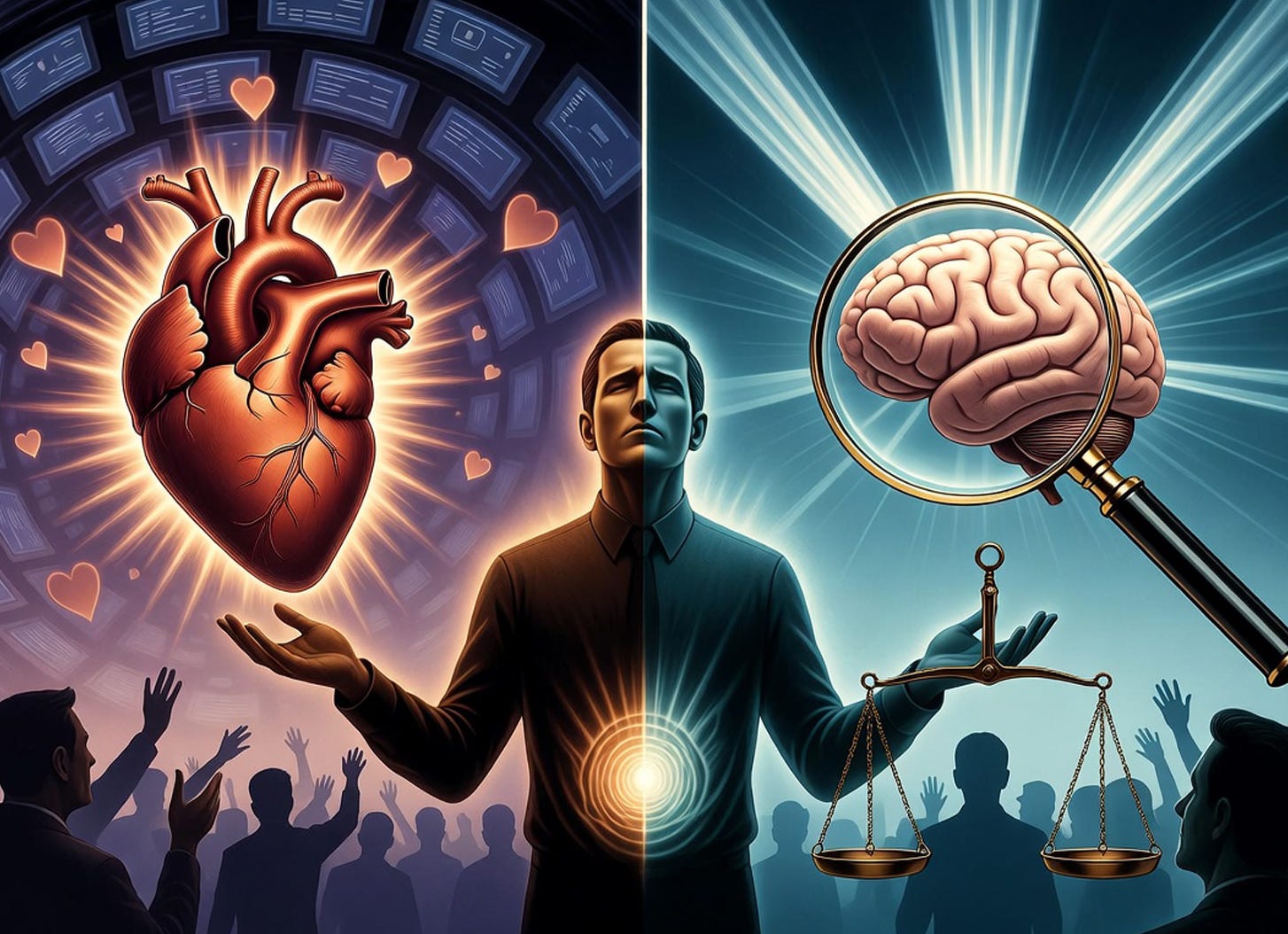
Sure, as long as we are conscious of their true origins. And even if not, sometimes we can trust, other times no. Feelings are odd things. They can come out of nowhere, or they can be highly circumstantial—like the rush of extreme fear when a bear jumps aggressively from behind a tree. They can also be mysterious “gut feelings.” Usually, we have some awareness of their unconscious underpinnings. We sense whether a feeling is a solid “gut” instinct, something “creepy,” or simply “good”—as in, “I just liked that guy; there was something about him that made me feel comfortable and trusting.”
But . . . and it’s a big “but,” we know we have to be careful. The guy or gal who sweeps us off our feet on a first date needs further scrutiny. We have all fallen into that pit, haven’t we? It is a deep, dark chasm, and usually very difficult to climb out of. Did you ever wonder why, back in the day, marriage engagements often lasted what seemed an eternity? There were many social and cultural underpinnings, but one major reason was simply to get past the “swept off your feet” syndrome—to make what was largely unconscious, conscious.
So, what’s the big deal? If our impressions of things and people rely too heavily on feelings—especially when we are not conscious of their origins—we can end up in serious trouble. Most of the time, it doesn’t really matter what our feelings are about other people. We see an actor we like or meet someone in the grocery store we immediately dislike. Actors don’t matter much in our daily lives; their entire craft is built on creating impressions based on unsubstantiated feelings.
Most strangers we encounter don’t matter much either. But people like our lawyer, our doctor, or our lover, do. With the exception of the latter, we usually have some objective basis for our assessments—what are their credentials? What is their reputation? Has the state licensed them? (As I clear my throat on that one.) We may still have a gut feeling, which remains important given their role in our lives, but we temper the emotional response with at least some objective evaluation.
We run into an odd situation with politicians. They are (or most people think they are) important, yet their persona and presentation are wholly geared toward generating a “feeling” with voters choosing among options. More often than not, they want that feeling to outweigh any objective facts. A lot of effort goes into this charade. Intellectually, many people may agree it’s a game, but most still fall for the ruse.
I see this often with celebrities, too. People worship movie stars or sports figures regardless of whether they are decent human beings. They reach worship status quickly. Sports stars at least have to have a exceptional physical skill. And oddly enough, most totally untalented actors seldom become celebrities. Hating these types (actors and athletes) is less common, but when someone is set up for hate for whatever reason, it flows effortlessly.
Guess who I am going to use as an example of this sort of hate? Donald J. Trump, of course. He is probably the most hated man in modern times next to Adolf Hitler (we could cite others like Joseph Stalin, Pol Pot, or Saddam Hussein, but Trump is the most current). Was he set up for hate? Absolutely, although not entirely. He can be rather despicable at times, making it easy to dislike him. Add a little media salt to his own formula, and you have one of the juiciest targets for hate projection imaginable.
To start with, Trump does not have a conventionally likable personality. He comes across as arrogant, impulsive, boastful, and low on agreeableness and emotional stability—traits like rudeness, grandiosity, and a lack of empathy that many find off-putting. He is blunt, disruptive, and often vulgar in a way that violates traditional political norms. Not much there for broad appeal.
Yet some of these brazen attributes are exactly what his supporters adore. His maverick, no-nonsense approach—telling it like he sees it with little filter, rejecting political correctness, and fighting the establishment—resonates deeply. Supporters value his authenticity, pragmatism, and willingness to shake up the system rather than play the polished insider game. What critics call arrogance or bullying, fans see as strength, decisiveness, and refreshing honesty. Which set of attributes do you think make a better leader? Sadly, the ugly ones probably do.
What about the “real” good and bad things? Haters rarely focus on substantive presidential shortcomings. Instead, they attack his personality: he’s mean, ugly, makes fun of people, has weird hair, is fat, and has an ugly mouth. They label him a misogynist, a racist, and a felon. Defenders note that many accusations stem from selective outrage, legal warfare perceived as political persecution, or misrepresentations of his record on issues like criminal justice reform (First Step Act), opportunity zones for minority communities, and strong support from diverse groups in elections. Supporters argue his blunt style gets twisted into “-isms” while ignoring policy outcomes or context.
Many of the Trump haters adore figures like Biden, Harris, Obama, or (for Canadians) Carney. Why? For mostly the same superficial reasons—personality, looks, media framing—rather than deep substance. They were told to love these figures and hate Trump (and his team). Although personality and appearance play a role, the press drives most of it. Most people don’t look beyond that.
So, they treat politicians like movie stars or sports figures. Their gut tells them one thing, looks and personality another, and the press fills in the rest. Then they retreat into echo chambers where their bias is confirmed endlessly by social media, friends, family, the dog—and maybe a cat or two (cats are primarily liberal).
Feelings have their place. A strong gut instinct can protect us or guide us toward what feels right. But when it comes to high-stakes decisions—especially about leaders who shape laws, economies, and societies—we owe it to ourselves to dig deeper. Scrutinize records, policies, and results alongside the vibe. Conscious awareness of where our feelings come from turns raw emotion into informed judgment. Without that, we’re just another audience member swept up in the performance.
As I revisit this concept in our modern time, the divide feels even starker. The “feeling-based” politics hasn’t faded; if anything, it has intensified. Trump remains a lightning rod—loved or loathed largely on emotional and media-primed grounds rather than calm analysis (although that has changed a bit since the Iran conflict). The lesson holds: question the origins of your feelings, especially when the stakes are this high. Shrews stay sharp by balancing heart and head.
Ambrose Bierce described the Presidency as "The greased pig in the field game of American politics." and a Politician as "An eel in the fundamental mud upon which the superstructure of organized society is reared." If one keeps both these descriptions in mind, the political world and its inhabitants remain simply a curious stage play.
Good morning shrews! I have never understood the over-the-top admiration for celebrities or sports figures. We are presented with what they want us to see and who knows who they really are underneath all that polish and glitz. The one thing I do admire (mostly) about Trump is he doesn't hold much back and yes, sometimes that backfires badly. However, I would rather have some bluntness than make-believe behaviour that we saw with Biden/Harris and of course, now with Carney. They have perfected the 'agreeable, I'm open to all ideas" bullshit that so many suck up as if it is real. I seriously think too many people prefer fake over real.