
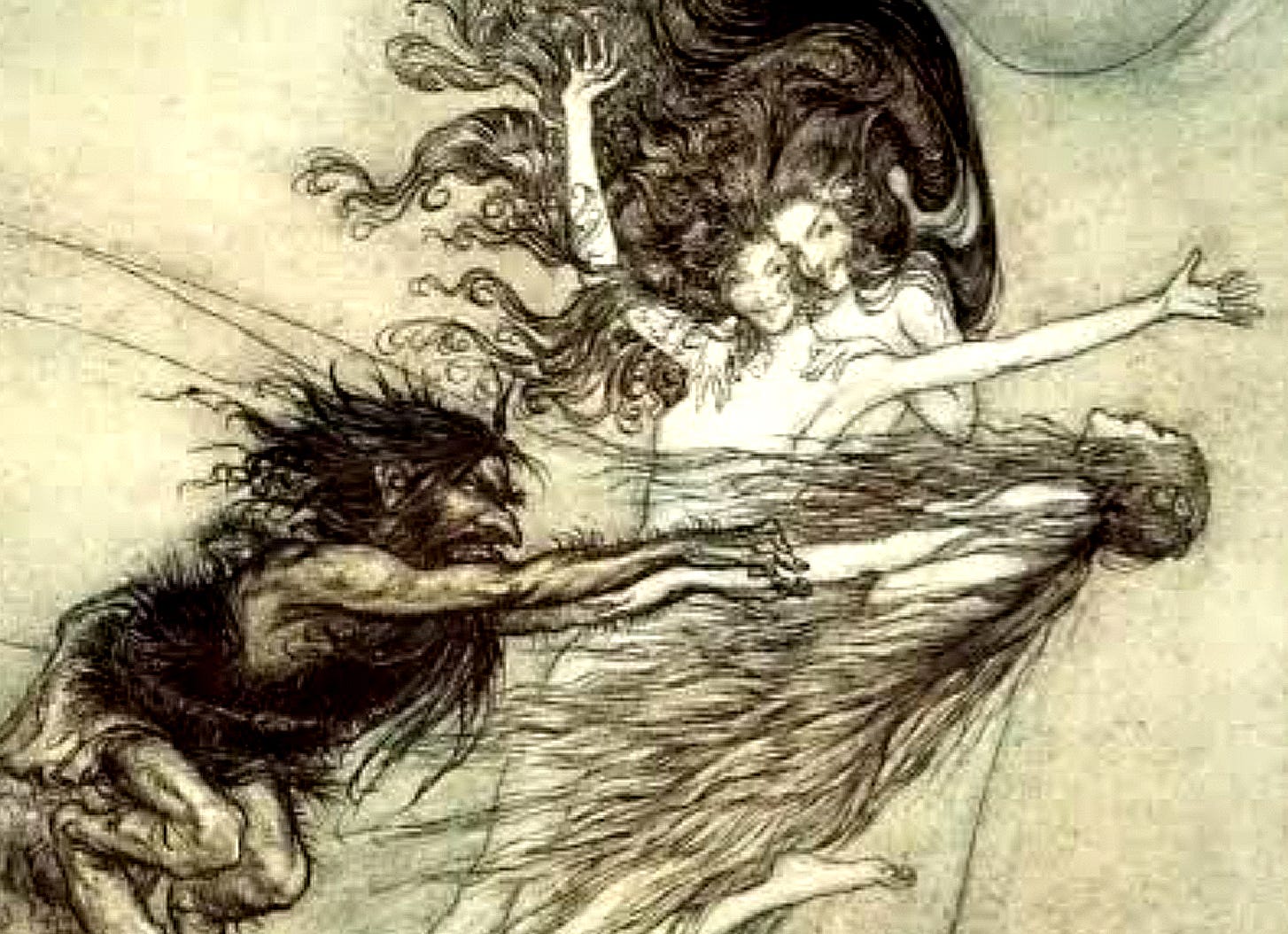
Alberich is a character in Richard Wagner’s Ring Cycle—a fifteen-hour operatic extravaganza of gods and goddesses, heroes, warrior princesses, giants, mine-dwelling dwarves, and aquatic Rhinemaidens. Alberich was a dwarf who made his way to the Rhine to cavort with its mermaid inhabitants: the sexy, cunning Rhinemaidens who guarded the river’s sacred lump of gold.
Able, miraculously, to move among them in their watery realm, Alberich seeks love from the flirting water-damsels. They tease him relentlessly with their shadow-feminine coercion. Eventually he has had enough of the abuse and launches into the famous curse-of-love aria whose fragments echo through the rest of the fifteen-hour epic.
This moment becomes the foundation of the entire Ring Cycle. After being rejected in his pursuit of true love—expressed through his wish to engage with the physical Rhinemaidens, presumably in a sexual manner—Alberich shifts his focus of acquisition to the material gold the lovely girls are guarding. Distracted by his clumsy attempts to seduce them (who in their right mind could ever love such an ugly thing?) and wholly unaffected by his amorous efforts, they drop their guard. Alberich seizes the gold. Before doing so, he renounces love itself and proclaims that anyone who possesses the gold will lose love as well. The gold is thus saddled with this curse—the renunciation of love. Consequently, the curse replaces the greatest of human potentials, love, with the pursuit of material wealth and power.
How appropriate. Isn’t this what we currently see in modern society? And it was obviously present enough in Wagner’s time (roughly 1859–1882) for him to use it as the foundation of his epic opera cycle. Love (soul) replaced by material idolization (the Bible’s golden calf). Humans have struggled with this since day one. Love is of the soul, of God, of all metaphysical reality; gold is material. It is wealth with monetary value, and with it comes power. That power is either obvious—ruling and controlling other people—or more subtle: the ability to summon, at will, instant gratification through consumption that tries to satisfy the senses and the intellect.
Humans generally express love through relationships—with children, with friends and family, with God, and most prominently with a significant other, a sexually compatible partner. This is what Alberich, the masculine side of this two-sided coin, was attempting to do in the watery confines of the Rhine. But he was doing it all wrong. He wanted payment from the Rhinemaidens (sex, which is the masculine conduit of expressing divine unity consciousness: love) without paying their due—which is the King’s offering of presence, protection, and passionate cherishing: the safety, honour, and steadfast devotion that allows the feminine to open in receptivity rather than tease, withhold, or turn her radiance into a weapon.
Tsk, tsk.
The lovely maidens did not respond to the dwarf’s beastly demands because they did not understand his divine needs, and he did not respond to the maidens’ divine needs because he did not understand them either. Again, another prominent resonance with modern—as well as not so modern—culture. Why did neither party understand the very basics of divine love as it is expressed in material bodies? (Even though both the Rhinemaidens and Alberich are decidedly not “human,” I believe Wagner meant for them to represent humans both spiritually and physically.) They didn’t understand, much as today’s modern humans typically do not understand, and as humans of bygone eras most likely did not understand as well.
Why? I can’t answer that question, but people have been trying to for millennia. More than likely, Alberich’s curse has been in effect long before his encounter with the Rhinegold. Humans long ago lost a clear and present relationship with the non-material and with how the non-material—love—interrelates with the material, as in the female and male bodies and psyches. Women require different needs to be fulfilled before they can fulfill the needs of men. Typically, if done correctly, these needs are met naturally and organically; one is not provided merely as a result of the other being supplied. Neither side needs to comprehend the complexities of the other’s needs. The supply is natural according to archetypal law, and as long as nothing blocks it, the flow is consistent and reliable.
But what if there is a block? In Alberich’s case, the block was more than likely ignorance formulated through childhood trauma. No one watching the opera is given any backstory to Alberich’s early formative years (do Nibelungs have childhoods?). The Rhinemaidens mention an unnamed father who told them to guard the gold, but that is all. Their family of origin is never assessed. We cannot be sure what unconscious complexes prompted the shadow behaviour of these figures. We only know it happened as Wagner scripted it. But did he just make all of this up, based on no real human precedent? No, he didn’t. Real humans are often caught in the same dysfunctional dynamic, minus the fantasy symbols of mermaids, dwarves, and lumps of gold.
As a practicing psychotherapist, I see countless men in couples therapy in constant pursuit of their female partners for the divine expression of love through sexual connection, only to be rejected with shadow, misunderstanding comments such as “All you think about is sex” and “Sex shouldn’t be that important.” But alas, it is that important—to him. And to Alberich. The Rhinemaidens mock him, laughing at his seemingly barbarous effort to experience love. And that is just what it looks like on stage: Alberich stumbling across the rocks at the bottom of the riverbed in an attempt to get his hands on the spritely maidens, so agile in their watery environment. He looks like a fool, blinded by physical lust and toxic desire. Is he a fool? No.
It is interesting to note that in his frustration with failure, he curses love, not lust (which is what the female water-sprites believe they are withholding). If Alberich truly believed all he wanted was a water-tumble with the girls, he would not have cursed love; he would have cursed lust. It was love he was seeking. It was love he was denied. As a typical male, physical sex was the primary conduit through which he could experience divine love. So, this is what he thought he was asking for. Until he didn’t get it. Then he decided to renounce love for all who chose the power of the gold in place of the pursuit of love, starting with himself.
I doubt Alberich actually knew this (that it was love he was seeking), as most modern men don’t. But Wagner did. And in his genius, he used Alberich to let the audience know: curse all who worship the material over love.
So, Alberich says, in effect, “To hell with love! What is it that I can get instead? What can I get that does not require female approval?” He should have asked himself instead, “What do I need to give to the Rhinemaidens for them to give me what I need?” And that is, indeed, a huge part of the problem in today’s romantic partnerships. There is a substantial lack on either side of the coin in understanding the needs of the other. Since the archetypal systems automatically provide these needs without requiring anyone to understand them when all is functioning as it should, no one makes much effort to understand much of anything because they don’t have to. It is only when the setup for the archetypes to function smoothly is not present that suddenly nothing works right. In today’s culture, this happens more often than not. Patriarchal males, shadow warriors, “Me Too” movements, and radical feminism all do not bode well for smoothly running archetypal systems.
So, what do we do about all this? We make an attempt to really understand what your partner needs to feel loved, desired, and romantically fulfilled. Believe it or not, men and women are different in this regard (and in many other regards as well). Don’t believe the common mantra of today: “Men and women are the same.” They aren’t. They are clearly equal in value (and the women have a slight edge on this account), but they are not the same.
Since Alberich is a mythological symbol, I don’t think there is anything he could have done differently to elicit love from the Rhinemaidens. Neither could they. They were built to do just what they did: represent the shadow archetypes that ultimately caused the renunciation of love. We, as humans, are not the same as these mythological representations. We can do differently, and we can love differently. We do not have to shift our attention to satisfaction from the material world—wealth and power—when acquiring love becomes difficult. We have to stick with it and realize there is no substitute for it. And I am not speaking only of the romantic love between two sexually compatible human beings; I am speaking of any expression of love—toward children, friends, animals, nature, art, music, and all creative passions. This is what brings meaning and purpose into our lives. And, needless to say, this should be the prime directive of a healthy human being.

If you would rather not subscribe at this time, and maybe give a little just for this article, please click the button above and give as much as you feel is comfortable. This helps me immensely in keeping up with my writing! Thank you so much!